The Difference Between Tea Fixation Machines and Integrated Fixation & Drying Machines
The core difference between tea fixation machines and integrated fixation & drying machines lies in functional positioning, coverage of processing procedures, and applicable scenarios. The former focuses on a single key process, while the latter integrates multiple processes to meet different production needs. Detailed differences are compared from 6 dimensions as follows:
1. Core Function: "Single Process" vs "Integrated Multiple Processes"
This is the most essential distinction, directly determining the core value of the equipment:
-
Tea Fixation Machine: Highly specialized, only responsible for the "fixation" process in tea processing.Fixation is the first critical step in tea processing. Its core purpose is to quickly inactivate polyphenol oxidase in fresh leaves at high temperatures (usually 200-300℃) to prevent oxidative browning (avoiding fresh leaves turning red or tasting bad). It also evaporates part of the moisture (softening fresh leaves for subsequent rolling) and retains the fresh and refreshing aroma of tea (such as the bean fragrance or chestnut fragrance of green tea).It does not have a "drying" function, so the fixed tea leaves must be transferred to a drying machine for further drying.
-
Integrated Fixation & Drying Machine: Integrated in function, capable of completing two core processes—"fixation" and "drying"—simultaneously.Drying aims to further reduce the moisture content of tea leaves (from 50%-60% after fixation to below 5%), shape the tea (such as the needle shape or flat shape of green tea), enhance the aroma (stimulating roasted fragrance through high temperature), and extend the shelf life.Through program control or structural design (such as a segmented temperature-controlled drum), this type of equipment allows fresh leaves to proceed from "fixation" to "drying" without transfer, realizing "one-machine continuous processing".
2. Processing Procedures: "Single Step" vs "Continuous Process"
The two play completely different roles in the tea processing chain, corresponding to different production flows:
| Equipment Type |
Coverage of Processing Procedures |
Production Process Example |
Requirements for Process Connection |
| Tea Fixation Machine |
Only fixation (single process) |
Fresh leaves → Fixation machine (fixation) → Rolling machine → Drying machine → Finished product |
Manual/mechanical transfer of fixed leaves is required, relying on other equipment for connection |
| Integrated Fixation & Drying Machine |
Fixation + drying (dual processes) |
Fresh leaves → Integrated machine (fixation → drying) → Rolling machine (optional) → Finished product |
After fixation, it automatically enters the drying stage without transfer |
Note: Some teas (such as flat green tea) require adding a rolling process between "fixation" and "drying". Integrated machines can be compatible with "temporary storage after fixation" or "direct connection to rolling", with flexibility varying by model.
3. Applicable Scenarios: "Large-Scale Professional Processing" vs "Small-Scale Convenient Processing"
The applicable scenarios of the two differ significantly, mainly depending on production scale, tea variety, and quality requirements:
Tea Fixation Machine Application Scenarios
- Large tea factories/professional processing plants: Need to process different types of tea in batches (green tea, black tea, oolong tea, etc., with great differences in fixation processes). Pursue precise control of fixation quality (e.g., green tea requires short-time high-temperature fixation, while black tea requires low-temperature slow fixation). Subsequent processing links (rolling, drying, sorting) are clearly divided, requiring specialized equipment to ensure the professionalism of each process.
- High-quality tea production: Such as pre-Ming green tea and premium oolong tea, which have extremely high requirements for the accuracy of fixation temperature and time (error needs to be controlled within 5℃). The temperature control system of special fixation machines (such as intelligent temperature-controlled drums) is more likely to meet the requirements, avoiding parameter compromises caused by process integration in "integrated machines".
- Multi-variety compatibility needs: Can adapt to the fixation needs of different teas (green tea, black tea, yellow tea, etc.) by adjusting fixation parameters (temperature, speed, duration), with strong versatility.
Integrated Fixation & Drying Machine Application Scenarios
- Small tea workshops/family tea making: Small production scale (processing less than 50kg of fresh leaves per day), limited space, unable to purchase multiple specialized equipment. Need "one machine to complete core processes" to reduce equipment investment and operational complexity.
- Processing of a single tea variety: Such as local characteristic small-variety green tea and farm tea, with fixed processing processes (simple fixation + drying flow) and moderate quality requirements, without the need for extreme parameter control.
- Outdoor/temporary processing: Some portable integrated machines (such as small electric heating models) are movable, suitable for tea farmers to process on-site near tea mountains, reducing losses during the transportation of fresh leaves (fresh leaves need to be fixed within 2 hours after picking, otherwise they are prone to deterioration).
4. Equipment Structure: "Professional Targeted Design" vs "Integrated Design"
Structural differences directly serve functional needs, specifically reflected in:
-
Tea Fixation Machine: Structurally designed around "efficient fixation" with targeted core components:
- Heating method: Mostly gas, coal-fired (for large models) or electric heating (for small models), with high heating power (ensuring rapid heating to fixation temperature).
- Core components: Drum-type (mainstream, fresh leaves are evenly heated by turning in the drum), pot-type (traditional, suitable for small-batch manual assistance), steam-type (low-temperature fixation, retaining more nutrients but low efficiency).
- Temperature control system: Precision temperature controller (some with PID automatic adjustment) can real-time monitor the temperature inside the drum, avoiding insufficient fixation (leaves turning red) or excessive fixation (leaves scorching at the edges).
-
Integrated Fixation & Drying Machine: Structure needs to balance "fixation" and "drying", with the core being "segmented temperature control" and "process connection":
- Heating method: Mostly electric heating (facilitating segmented temperature control) or gas heating (for large models).
- Core components: Dual-segment drum (high-temperature fixation in the front section, medium-low temperature drying in the rear section), stirring device (preventing tea leaves from clumping during drying), dehumidification system (needing to discharge moisture during drying to avoid tea leaves reabsorbing moisture).
- Temperature control system: Dual-zone or multi-zone temperature control. The front section (200-300℃) is for fixation, and the rear section (80-120℃) is for drying. Some models have an automatic timing function.
5. Processing Effect: "Quality Priority" vs "Efficiency Priority"
The difference in processing effect between the two is essentially a trade-off between "professional division of labor" and "integrated convenience":
| Comparison Dimension |
Tea Fixation Machine (+ Specialized Drying Machine) |
Integrated Fixation & Drying Machine |
| Fixation Quality |
High: Precise temperature and time control, even heating of fresh leaves, and better retention of aroma (e.g., the freshness of green tea) |
Medium: Needs to balance drying parameters, resulting in slightly lower fixation temperature or shorter time, and easy slight loss of aroma |
| Drying Quality |
High: Specialized drying machines can adjust parameters according to tea shape (e.g., needle shape, flat shape) for more regular shaping and prominent roasted aroma |
Medium: Fixed drying intensity, slightly poor shaping effect for irregular tea leaves (e.g., curly shape) |
| Moisture Control |
Precise: Stable moisture content after fixation (50%-60%), and can be reduced to below 5% after drying, not prone to reabsorbing moisture |
Average: If the moisture content is too high after fixation, drying may be incomplete, and the tea is prone to deterioration during long-term storage |
| Applicable Tea Varieties |
All varieties (green tea, black tea, oolong tea, yellow tea, etc.) |
Mainly green tea and white tea; not suitable for oolong tea (needing complex processes of "shaking green + fixation") or black tea (needing "withering + fixation") |
6. Operational Complexity: "Professional Operation" vs "Easy to Use"
-
Tea Fixation Machine: High operational threshold, requiring professional personnel to master parameter adjustment.Parameters such as temperature, drum speed, and feeding volume need to be adjusted according to the tenderness of fresh leaves (tender leaves require low-temperature short-time fixation, old leaves require high-temperature long-time fixation) and variety (e.g., Longjing requires high-temperature rapid fixation, Biluochun requires medium-temperature slow fixation). Novices are prone to "insufficient fixation" or "excessive fixation".
-
Integrated Fixation & Drying Machine: Easier to operate, suitable for novices or non-professionals.Most models have preset programs such as "green tea fixation and drying" and "white tea drying". Users only need to select the corresponding mode and put in fresh leaves without frequent parameter adjustment, resulting in low learning costs.
Summary: How to Choose?
- If you are a large tea factory, pursue high-quality tea (such as premium green tea or oolong tea), or need to process multiple tea varieties, prioritize a tea fixation machine + specialized drying machine to ensure quality through professional division of labor.
- If you are a small workshop, engage in family tea making, only process a single variety (such as local green tea), or pursue convenience and low cost, prioritize an integrated fixation & drying machine to realize "one machine completing core processes" and reduce equipment investment and operational difficulty.
Recommended Equipment (Selected from the Document)
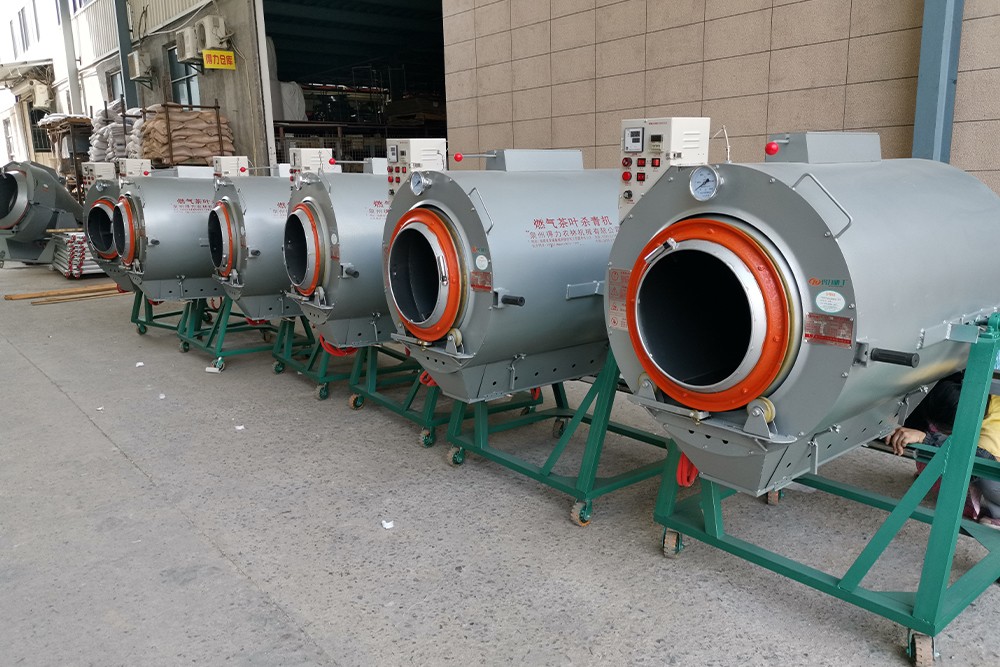
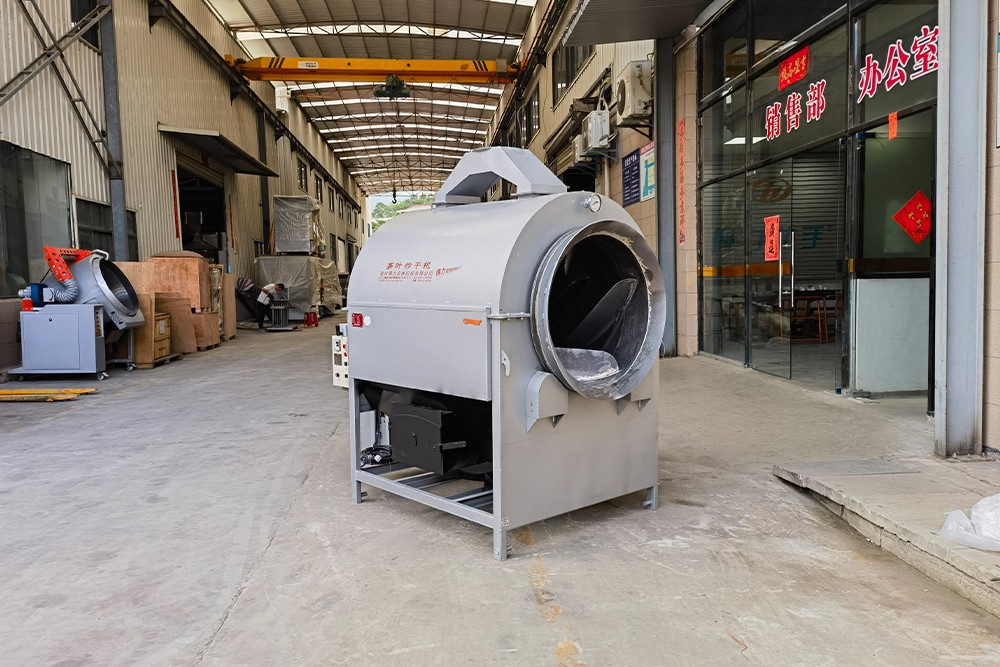
- Core Parameters: Inner drum material (carbon steel/stainless steel), drum diameter 700mm, drum length 1000mm, voltage 220V 50Hz, drive motor power 0.75KW, drum speed 5-37rpm, capacity 50kg/hour.
- Recommendation Reason: Gas heating ensures rapid temperature rise, suitable for medium-scale production. Multiple material options (carbon steel/stainless steel) meet different quality and budget needs, with stable capacity and wide applicability for green tea, yellow tea, and other varieties.
- Model: DL-6CSTP-CM110
- Type: Tea Fixation Machine & Revolving Dryer Machine (Carbon Iron Pot)
Core Technical Parameters
| Parameter Category |
Specification |
| Dimension |
1300 × 2100 × 2000 mm |
| Voltage |
220V / 380V, 50Hz |
| Drum Diameter |
1100 mm |
| Drum Length |
1000 mm |
| Drum Materials |
Carbon Steel |
| Drum Thickness |
4 mm / 8 mm (optional) |
| Drive Motor Power |
1.5 kW |
| Exhaust Fan Power |
0.18 kW |
| Blower Fan Power |
0.15 kW |
| Rotate Speed |
5 - 37 rpm |
| Heating Type |
Compatible with Wood, Coal, Wood Pellets, or Biomass Fuel |
| Capacity |
35 kg per batch |
| Price Options |
- Price (Normal Steel Drum)- Price (Stainless Steel Drum) |